
Recently, the first longer trailer for Christopher Nolan’s The Odyssey made viewers raise their eyebrows. Their criticism about dull colours and historical inaccuracy isn’t unjustified and points to larger issues in the work of one of Hollywood’s most celebrated directors.

Particularly in the intellectual corners of the World Wide Web, the clip was widely received negatively, mainly for two reasons that threaten the believability of the adaptation. First, its grim, desaturated look was considered by many to be inadequate for the colourfulness of the Mediterranean. And secondly, the costumes were criticized for their dullness and historical inaccuracy.
Indeed, the first glimpses of Hollywood’s take on Homer’s ancient epic aren’t exactly bursting with colour. Instead, they’re dominated by cool, dark tones, negative spaces and shadows. If at all, the sun shimmers through Hollywood’s infamous sepia-coloured Mexico filter. Many Twitter users have mocked the British director Nolan for making their sun-kissed Mare Nostrum resemble autumn in the rainy English countryside.
It’s precisely this sepia-based aesthetic that has become Nolan’s visual signature, or, more critically, a colour mask that he has indiscriminately imposed on each of his films to date.
While this cinematic approach worked wonders for Nolan’s uber-realistic reboot of the Batman franchise (a trilogy I deeply admire), it worked less well for films that invited more daring palettes, such as the dreamy Inception (2010) or space-based Interstellar (2014). Hence, it doesn’t seem unlikely that even Nolan’s wildest dreams are in brown and grey. The following tweet really hit the nail on the head:
While I understand the intrigue in a heavy, noir, almost horroresque Odyssey, having read it and the Iliad enthusiastically at a young age, I would have preferred an approach that reflects the exuberant colours of Greece, with its lush vegetation, crystal-clear water and bright blue skies. I don’t even think that the two are mutually exclusive.
Nolan, however, clearly took a different route, evidenced by the fact that filming also took place in Iceland and Scotland (brrrrrr), two locations he has used on several occasions before. Equally surprising, the beaches in the trailer were filmed on the Moroccan Atlantic coast with its flat sand beaches instead of the rugged and rocky shoreline of Greece.
In general, it seems as if historical accuracy wasn’t Nolan’s most pressing concern, to put it mildly. This applies even more so to the costumes.
Bow Down, Odysseus!
The most memorable and most controversial shot of the trailer belongs to the mythological figure of Agamemnon (the Greeks’ and Odysseus’s overlord during the preceding Trojan War). Or rather, it belongs to the curious design of his helmet. Imposing, futuristic and in dark steel optic (featuring a golden spine imitation at the back of the neck?!), it has prompted Twitter users to draw diverse comparisons, whether to Batman, Darth Vader, AI slop, or the output of a 3D printer.

The costumes underlying message seems as little subtle as Agamemnon’s helmet is antique-looking: This character is an uber-dominant and powerful figure with possibly dark intentions that demands the utmost respect, which Odysseus (played by Matt Damon?!) dutifully expresses by kneeling down.
The teenager in me is in awe of this display of raw masculine power and Giga Chad energy. However, my current 29-year-old self, trained as a historian and political scientist, is sceptical. I highly doubt that expressions of loyalty and deference between two powerful Greeks were signalled as obviously and performatively as by kneeling down. And indeed, according to a Harvard academic, the act of kneeling to a king (proskynesis) in ancient Greece was regarded as essentially foreign, barbarian and un-Greek.
A Missed Chance
But back to the costumes. The armour of Damon’s Odysseus and his luck-deprived fellowship are neither creatively coherent nor historically accurate. Certainly, there would have been different design choices imaginable. Mycenaean bronze armour from the Trojan War period, with its distinct boar tusk helmets, would have been the most exotic but historically accurate version. Lighter linen-based armour with bronze applications from the age of the Odyssey’s creation would have been thinkable too.
Nolan could’ve also relied upon the classic imagery of Homer’s heroes, dressing his actors in the way Greeks and Romans from later antiquity imagined mythological armour. In the early production, Nolan’s team even contacted but later ghosted a Greek metal artist, who is widely renowned for handcrafting accurate ancient armour. What a missed chance!
There’s no one way to bring the Odyssey to the big screen that’s totally historically accurate, but if you’re going for a non-fantastic approach like Nolan clearly is (he’s even left out the Olympic gods), you can expect a bit of creative coherence. Instead, Nolan has chosen the dangerous middle road. He neither committed to a proper fantastical visual language that embraces exaggeration, nor to a historically coherent one that places the story somewhat consistently in one ancient era or antiquity at all.
What we seem to get instead is a random, ahistorical and uninspired potpourri of costumes vaguely Greco-Roman inspired. Whereas Agamemnon’s golden spine helmet (a detail which I kind of like) is futuristic, the armour of Odysseus and his men is completely interchangeable, like a colour-deprived cliché from previous Hollywood monumental films. And of course, Nolan didn’t have the spine (pun intended) to drop the Corinthian helmet, without which no Hollywood film set in antiquity seems to get by. How boring!
The culture of the ancient Mediterranean was anything but dull and desaturated. For example, the temples, which we nowadays mainly know in plain stone, were illustriously painted. And anyone who considered themselves to be someone loved to show off with a dazzling mix of colours and detailed accessories. Nolan seems to be indifferent to all of this; for example, why is Odysseus’s son Telemachus (Tom Holland) dressed like a medieval peasant from Northern Europe?
Why Accuracy is Important Even in Fiction
You might be wondering why all this matters in a story about cyclops, sirens, and the underworld. Like most fictional works, Homer’s Odyssey is ultimately grounded in human experience, imagination and a specific cultural-historical setting. Even the most fantastical stories establish a self-contained world with its own rules, technologies, social practices, and norms. This internal consistency is called diegetic coherence.
Similar ideas are the suspension of belief (audiences are willing to accept fantastic elements when they’re embedded in a consistent and plausible way) and the non-separability of form and content (for example, an overly ahistorical element wouldn’t only alter the visual appearance but also affect the truthfulness of the content itself). And even fantasy typically follows implied realism, in the sense that events have causes and actions entail consequences.
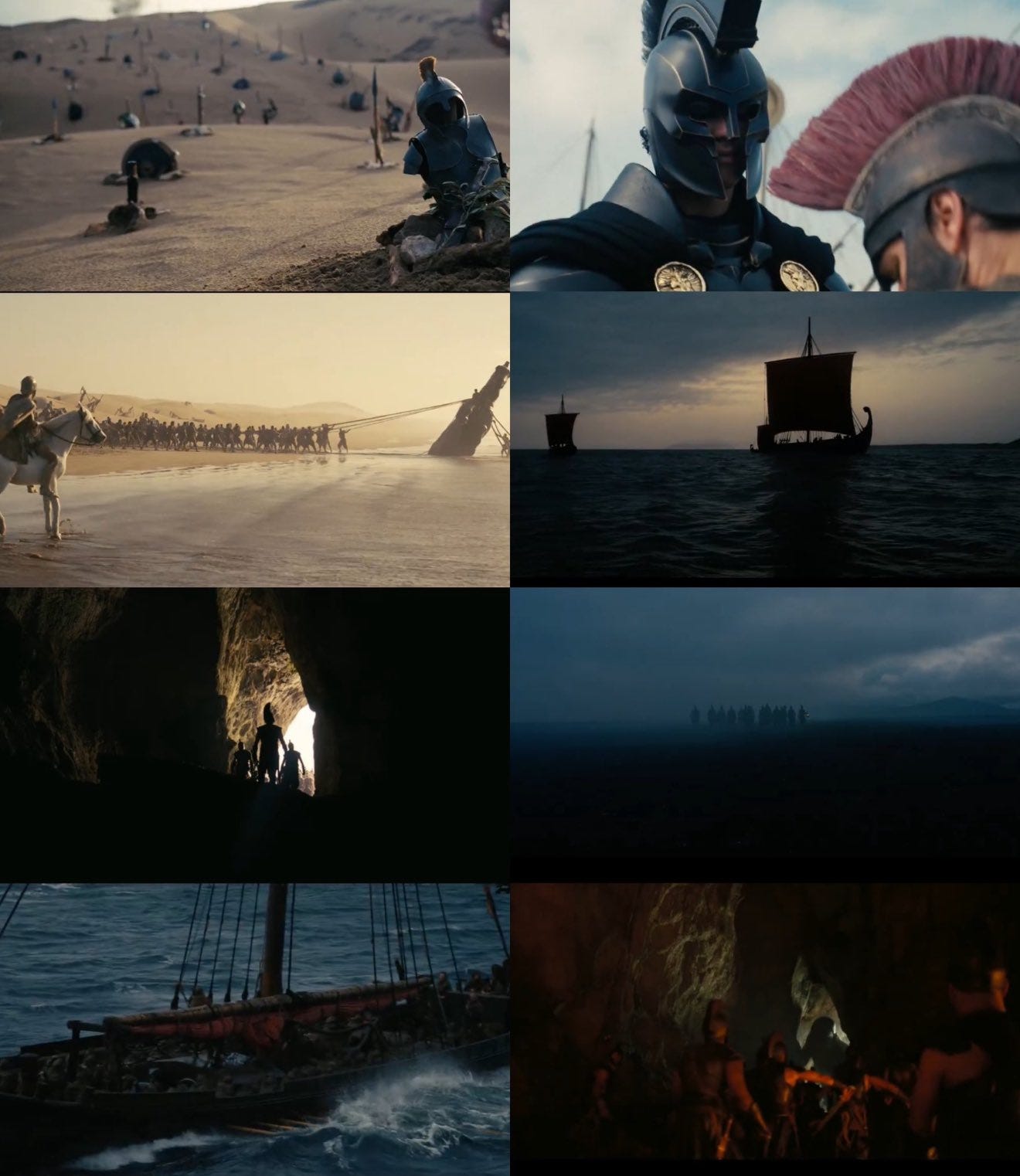
Already in the recent trailer, Nolan bends these principles to their breaking point with North African sand beaches, medieval-looking costumes, Viking-inspired ships, caricatured power relations, and deliberate colourlessness. And let’s not forget Agamemnon’s bizarre helmet, which could only have been made with modern machinery.
In my eyes, Nolan is also not doing himself any favours by fielding a predominantly Anglo-Saxon cast whose actors look anything but Mediterranean (give me at least Henry Cavill, please). All of this has nothing to do with realism, and perhaps the film should be better understood as loosely based on the Odyssey rather than as an earnest and respectful adaptation.
Optics Over Substance (Again)?
Nolan’s acclaimed technicality, along with his weighty pseudo-realism and his pursuit of high-gloss visuals that often come across as slick (reminding me of coffee-table books), becomes even more of an annoyance if it appears to compensate for the lack of a compelling, or at least comprehensible, plot, as in Tenet (2020). The highly acclaimed filmmaker thus runs the risk of mistaking optics and his usual roaring, overwhelming sound design for substance. Oppenheimer (2023), his latest work, falls into this category.
In this context, a sharp-tongued voice on Twitter argued that Nolan’s work was never actually “realistic,” but rather hyper-stylised. The problem with his monotonous aesthetic, the user continued, is that it is “typical of someone desperately trying to portray himself as much more serious than he is, while refusing to admit that he makes superhero and action films.” Ouch.
Others complained that the film, as a reflection of our times, embodies the aesthetics of generative AI, a claim I don’t find unfounded. And while Nolan is far from the only director who wholeheartedly embraces muted colours, he is leading the way and is described by many as modern cinema’s chief architect. During my research, I found out that Nolan has red–green colour blindness (no joke!). While this answers some questions, it raises others. What would his films be like if he could process red and green normally? And, more importantly, why is no one intervening?
Cinematically, Nolan, who also acted as screenwriter, is a far better architect and engineer than he is a storyteller, poet, or outfitter. This summer, he’ll be taking a detour into the ancient Mediterranean, which he tints with his muddy colour filter.
He will lazily populate it with various Hollywood stereotypes and clichés that half-heartedly mix hyper-stylisation and boring pseudo-reality. While the dreariness of Nolan’s aesthetics worked for many of his earlier films, The Odyssey shouldn’t have the same visual language as Batman, his noir thrillers, or his sci-fi movies.
Ancient Greece, and the mythology that emerged from it, was a vibrant, sun-drenched and colourful place. Questions and relations of power (at least at the top or among the Gods) were complex, nuanced and subtle affairs with many contradictions and semitones. Nolan turns this reality on its head by painting his Mediterranean in fifty shades of grey and by seemingly making human relations and politics brute, on-the-nose and clear-cut.
Nolan thus proves unable or unwilling to pay homage to the spirit of Homer’s Odyssey. The ancient epic feels light and imaginative, rich in strange adventures and a sense of wonder, yet it is never about cheap thrills or entertainment for its own sake.
Ironically, The Odyssey’s trailer has been perceived so poorly by classicists and film enthusiasts that they’re now grudgingly complimenting aspects of the disliked Troy (2004), which at least had sun, a coherent set design, detailed and appealing uniforms, and complex, interesting power relations and characters.
Now, I’m not ruling out the possibility that The Odyssey’s plot will ultimately blow us away, move us emotionally, and that Nolan will manage to give his Nordic-looking adaptation a convincing narrative meaning. The only problem is that his track record as a filmmaker and screenwriter doesn’t exactly inspire confidence in this regard.
The final verdict will have to wait until summer, but the omens from the gods aren’t promising…
